
Walden
A small town baseball star meets Thorazine

As was the case for many town residents, Walden Farragut’s problems basically started—but did not necessarily end— with the Rockwell County Schrodinger-Everett Power Plant. It was the first of a series of eight experimental Magnetically Activated and Condensed (“Big M.A.C.”) Plasma Reactors, which created power by compressing ionized gas with a very powerful magnetic field till electrons were entirely stripped from the atom’s nucleus and neutrons were crushed into radiant energy.
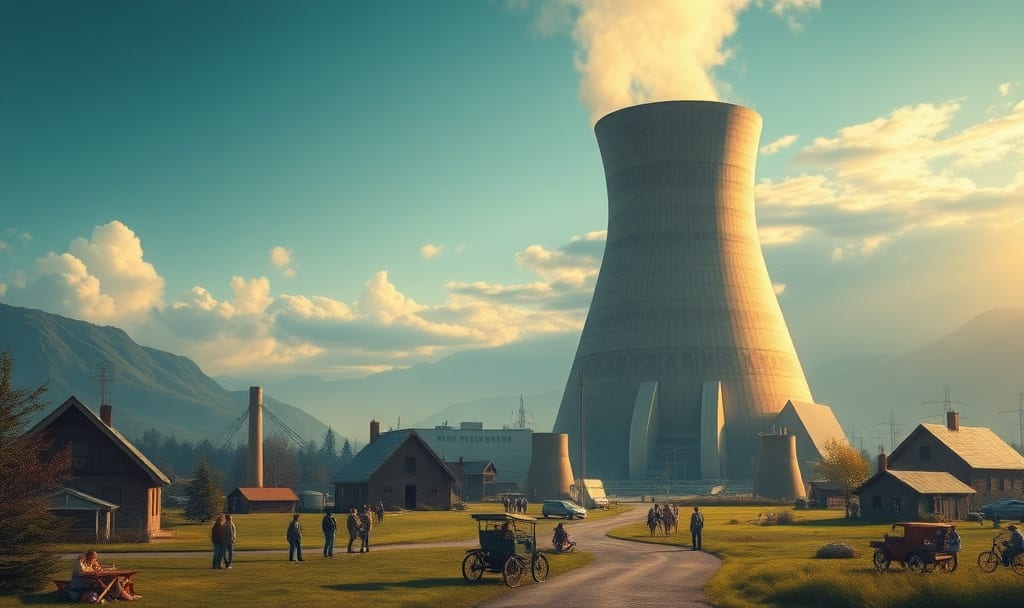
The theory behind this process was a subject of dispute, and the citizenry of Rockwell was by no means happy about having a facility in town that was actually hotter than the surface of the sun, but the federal government was enthused about it and the eggheads from Yule University received an incredible amount of grant money to study the effect. After a year of continual propaganda from the advertising department of the Rockwell Corporation, the Mayor and the Chamber of Commerce were sold, and construction was underway. The distinctive hamburger-shaped structure became the biggest and most recognizable building in town. When someone actually named a real hamburger after it very recently, there was a certain civic pride that came with the burger’s popularity. Though the restaurant franchise did attempt legal action early on, the “Big Mac” name in town was already well-known. Like it or not, the place had personality. You didn’t have to be a fan to pick it out on a photo.
When it began operation in the winter of 1949, however, there proved to be complications. Claude Metzger’s Theory of Nucleic Turbulence suggested that the seeming creation of new energy from the nuclear destruction process was not a local violation of the First Law of Thermodynamics, whereas local engineer Jared McWheel’s studies clearly confirmed that it was.
The Schrodinger design had succeeded where concurrent Cold Fusion projects had failed because the “Metzger Effect” supposedly drew a significant amount of energy from a small “sub-universe” coerced into temporary existence by the nuclear compression. Thus it could momentarily violate the law that all physicists held sacred: That neither matter nor energy could be created or destroyed. McWheel proved that the short-term availability of new energy during the neutron disintegration had long-term consequences outside the reaction. The first day of the plant’s operation, eight cars, two garages and six town residents went missing. Among the residents was the newborn Walden T. Farragut and a pediatrician who was attending to him at the time.
The fact that missing people and property were returned within ten days—with the exception of one 1962 blue Ford Falcon—did little to ameliorate public concern. But the impetus of government investment, corporate sponsorship and the twelve hundred new power plant jobs stemmed the tide of collective outrage and the traditional balance between the safety of the citizenry and the efficiency of the infrastructure was restored.
Yule University got its grants, Rockwell Corporation stockholders held onto their investments, and an average of forty two town residents a year went missing for no reason whatsoever; unexpectedly waking up in bus stations and McDonald’s restaurants all over the eastern seaboard with no idea what had happened to them.
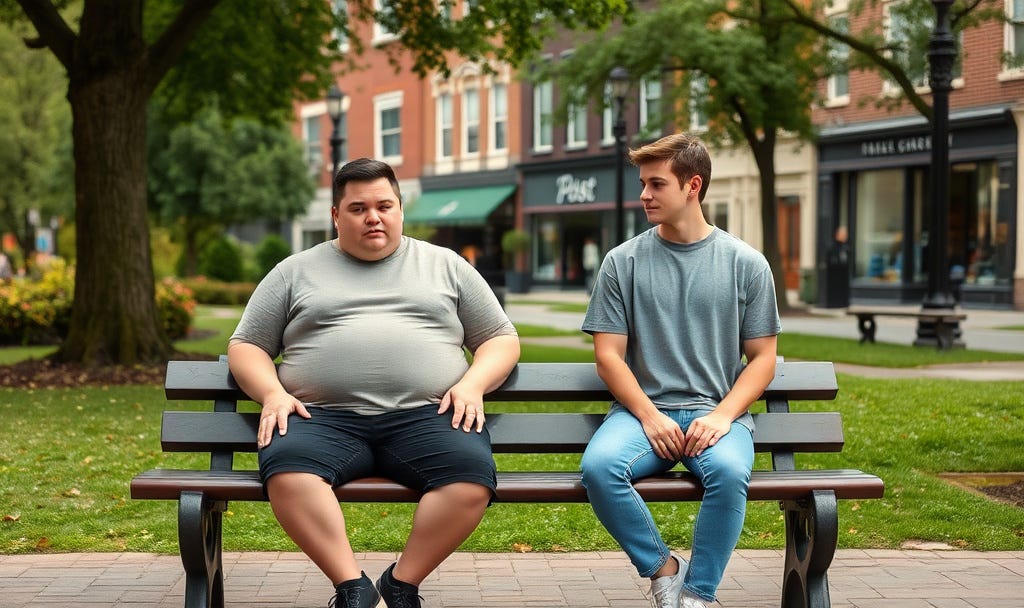
It was the ides of May in Rockwell, Connecticut and Walden Farragut was sitting on a park bench across the street from Sally’s Sub Shop. Sharing the bench for no particular reason was professional teenage truant Francis X. Bok, who was nursing a liter bottle of Ausenflacker-Bacher beer in a brown paper bag while waiting for Walden to say something funny or outrageous, which he inevitably did. You just had to be patient.
When Bobby Donato the fat cop asked Bok why he wasn’t in school on Wednesday morning at 9:45 AM, Bok explained that he was following an unsupervised personal release program which allowed him time to complete his science project. This involved him sitting on the town green or outside Sally’s Sub Shop for several hours a day to count the quantity of beer trucks and gasoline tankers which passed by. His theory was, according to Bok, that gasoline deliveries to service stations would increase in proportion to the available beer. So far, his hypothesis seemed to be working out. One needed a vehicle to go to work anyway, but extracurricular activities required additional driving and thus additional fuel. And most of those activities somehow involved beer.
As to why he had a liter bottle of Ausenflacker-Bacher beer in a paper bag near his feet, he explained that his father, a well-known immigrant stone mason, had volunteered to rebuild one of Ausenflacker’s brewing houses back in the old country after the First World War, and the beer company left the local liquor store a liter every Wednesday in appreciation.
Donato, bless his soul, was one of the less experienced officers who hadn’t yet fully sampled the truly prodigious capacity for bushwah exhibited by the local youth.
The truth was, of course, that Frankie Bok liked to leave school whenever he damn pleased and, when leaving for an extended period, he enjoyed the company of a good European beer.
He would argue that he chose the bench because everybody needed a place to be, and this one was both close to the liquor store and the sun at the same time.
But, Walden was also very frequently a real adventure. He was taking so much medication he didn’t need to sleep. He built himself a shortwave radio that could pick up the McMurdo NASA station in Antarctica and listened to weather balloon launchings and volcano sample testings all night long. He developed an electronic Faraday cage that, in theory anyway, would stop people and couches from disappearing—as long as they were inside their houses. Professor McWheel had a look at it and thought it was a pretty good idea.
His idea of a social life was somewhat different than that of the average eighteen year old boy.
On the surface, the two boys were very different. Bok was one of those wiry fifteen year old wise-guys who could skip school and eat two Sally’s Subs every day before lunch and not gain a pound. Walden was a few years older, a few inches shorter and over twice his weight. He was once a stunningly talented athlete who held his league’s stolen base record for two years. But that was before the pharmaceutical industry caught up to him.
Walden was a regular on the town green, but he was different shades of weird depending on the day. This morning he was just staring straight ahead at the row of brick storefronts across Church Street, his eyes motionless and dull, like a science fiction Zen master overloaded with sake. With his bright red Rockwell Rockets sweatshirt and three years of drug-induced water weight, he was a still white Buddha decorating the commons with a disturbing quiet.
The old brick plaza that bordered the north side of the town hall had been around since the First World War, but was presently comprised of the Sub Shop, the Rockwell Pharmacy, Rosie’s Beauty Salon and the photography studio that was evidently just called the Photography Studio. It was hard to tell which, if any, of these businesses were the object of Walden’s attention, but he was focusing as only Walden could focus. He had been out of school for almost five years without a job or a formal training program. If he wanted to stare at a storefront all day, he had plenty of opportunity.
Bok knew that Walden wasn’t a fan of eye contact. So he just saluted his companion with a raised paper-enclosed bottle and took a sip, listening to the strings of “An der schönen blauen Donau” in his memory as he drank. With a cold liter of Ausenflacker at the ready, the concert halls of Cologne and Vienna were never far away.
“No one’s immune,” Walden said, not turning, giving no indication that he was speaking other than to himself.
“I can dig it,” Bok agreed.
Walden was normally a quiet guy. He had been put on medication after the Schrodinger-Everett Reactor reopened in the winter of 1964. When the sky above the plant turned green, Walden had seemed the most eager person in town to talk about it. So the company psychiatrist recommended Thorazine for the hallucinations. The drug may not have eliminated the hallucinations, but he stopped talking about it.
“We think we’re masters of our fate,” Walden said. “That’s like saying the wind has free will because it’s heading in one direction.”
The glow was most noticeable in the early morning and evening, like a lime aurora over the horizon to the southwest. Even if someone came from Texas and pointed it out to a townie, nobody would talk about it. Even if they were naturally curious, they took a look at Walden, maybe took another look at his mother, and their curiosity was fully appeased.
“My dad was Master of his fate,” Walden said, staring straight ahead. “He got a job as an engineer at the plant the day it opened, bought a cape cod for ten thousand bucks on the G.I. Bill, raised a healthy family—and then the universe swallowed him whole like a guppy.”
Bok stopped himself from offering any lame professions of shared sorrow. He knew that, if he lost his dad, the last thing he’d want to hear from anyone else is that they knew how he felt and shared his sense of loss.
“But the Big Mac didn’t wait to tell me who was in charge. “ Walden said. “From the moment I was born—February 14th, 1949—it snatched me out of a perfectly good crib and terrorized the whole hospital for over a week, just to make a point. It didn’t matter whether or not you were an engineer trained to understand the plasma compression process. Understanding was not to be confused with control.”
He kept staring straight ahead at the front window of Sally’s like the Dallas Cowboys Cheerleaders were rehearsing inside. “About seventy five minutes after the Reactor started for the first time. I was missing for nine days.”
Bok reached down at his feet for the liter bottle of Ausenflacker he kept in a paper bag.
“Of course,” Walden reflected. “I had no idea I was missing. I had never been anywhere before.”

Ausenflacker-Bacher beer had a ceramic topped cork held on by a steel hook that attached to the thick brown glass of the bottle. When he pulled the cork, it came off with a satisfying pop, and his senses were tickled by the memories of the biergarten at the 1964 World’s Fair in Flushing Meadows.
“Good point,” Bok said.
He had heard this story from his mom, who had heard it from Mrs. Morgenthau across the street. Mrs. Morgenthau knew every single thing that happened in town. It turned out that two other babies and a pediatrician had gone missing at the hospital that day. They all turned up inside of a week. Otherwise, Mrs. Farragut would’ve been charged with four counts of kidnapping, for the crime of reporting her newborn missing before any of the other mothers noticed their loss.
Bok took a long swig of the beer. Although it was only ten in the morning and by no means hot outside, the excellent brew was uncommonly refreshing. You could almost hear the tubas and the accordions belting out the Liechtensteiner Polka.
The pediatrician was found the next day sleeping in a bus station in Scranton, Pennsylvania. Both babies were returned to the maternity ward before they found Walden. They moved his mother to the Psych Ward for monitoring since she displayed signs of clinical depression. His father thought that being charged with four kidnappings and losing a newborn child would account for the depression, but the Chief of Psychiatry put her on Miltown. She was still trying to discharge herself from the hospital, so they added pentobarbital. She stopped screaming about going home, but at that point she couldn’t recognize the passage of time and couldn’t care for a child. When she returned home, she was on so much medication, she couldn’t drive a car, heat up milk for baby Walden or hold a part-time job bagging groceries.
At this point, Bok would normally have offered a companion a swig of beer. But he thought better of it. A kid with that much dope in him already was probably not a good candidate for a beer buzz.
Professor McWheel at school had explained the principle behind the Schrodinger-Everett Reactor once:
“Basically, it’s powered by highly compressed nuclei contained in a very strong magnetic field. As they’re compressed, heat is expelled and power is created by capturing that heat and diverting a percentage of it back to maintaining the magnetic field, allowing neighboring neutrons to absorb energy while facilitating a sustainable reaction.”
It got a little breezier and a little colder as the sun disappeared behind the low-hanging clouds, and Bok started buttoning his denim jacket.
“People wonder how I grew up at all with Mom being like she was. Dad was a big help. And I learned pretty well to take care of myself,” Walden said. “I made the baseball team, kept a B average. In eighth grade I had the league’s stolen base record. Then, it all came undone when I shot my mouth off about the green glow.”
“Well, not for nothin’, but there is a green glow,” Bok maintained. “And everybody knows there’s a green glow.”
“That’s the beauty of the Big Mac’s power,” Walden said. “Everybody knows there’s a green glow. So nobody ever hears about the green glow.”
Across the street, Sally’s window shook as if a trailer truck was passing by. There was nobody on the street besides a Schwinn 3-speed bike.
“I would’ve gotten used to the Thorazine,” Waldo said. “I could still hit a baseball and do most of the math. Then, my dad went missing a week after the plant started up again. When I reported him missing, the company doctor prescribed Fluphenazine.”
“What’s Fluphenazine?”
“It’s an anti-psychotic,” Walden explained. “The doctor diagnosed me as delusional.”
“I don’t get it,” Bok admitted. “Your dad was really missing.”
“Nobody reported it except me.”
“Right,” Bok sagged against the back of the park bench.
“I could hardly stand up with all that dope in me,” Walden said. “Back then, I wasn’t any heavier than you. I was late to school every day, I couldn’t focus to read the board and didn’t understand the homework. When my grades started slipping and I started to get disgusted, I was diagnosed with clinical depression by the school psychiatrist. They put me on Librium.”
There was a clap of thunder from the building across the street and loose chunks of mortar dislodged from the brick face.
“At that point I was feeling better about my D- average, but my teachers were complaining that I wasn’t paying attention in class—which, in their defense, was perfectly true. The school shrink recommended Ritalin for Attention Deficit Disorder.”
Sally’s front window was like a funhouse mirror mounted in hot sand, making the trees on the commons and the parked cars on the street shimmy and stretch while the sunlight danced across the glass.
“By the last week of practice, I couldn’t tell you what inning I was playing or what base I was on. The coach was real supportive but it was pretty obvious I was no longer baseball material. I finished the year with an incomplete, my mom took me out of school and that was the end of my academic career.”
“Bummer,” Bok summarized.
Walden returned to his resolute staring. The wind kicked up. Bok’s denim jacket was no longer proof against the cold.
“But I learned something,” Walden said.
“‘Bout what?”
“About Reality,” Walden explained. “It’s not the unmoving, firm foundation it’s reputed to be.”
Somebody’s New York Times came sliding down the middle of church street, unfolding itself as it went, sending three foot black and white banners up into the air, plastering themselves against parked cars and conifers as they flew.
“Professor MacWheel used to insist that matter could be neither created nor destroyed,” Waldo said, his monotone meandering somehow rising above the wind and the shuddering of the storefront windows. “Now he admits that the Schrodinger-Everett Reactor squeezes kilograms of highly compressed neutrons out of our space entirely and into one or more potential universes any citizen of Rockwell can fall into at any given moment.”
“Don’t know it’s as bad as all that,” Bok temporized.
“The Laws of Thermodynamics are under attack. And nobody cares.”
“Well, not for nothin’, but it’s not like anybody can do anything about the bleepin’ Laws of Thermodynamics.”
“Exactly,” Walden confirmed. “There seems to be no way to address the fact that our universe is leaking forty one people every year from this town alone. So we wax eloquent about the Middle East War and the trade deficit with Japan or the two new firemen added to the town budget.”
“Don’t know that we can do much about the deficit or the firemen either.”
“But at least they’re tangible. You can vote against the firemen. But you can’t vote against the fire.”
“Fact,” Bok agreed.
“Our news media and our government encourage us to believe that human events are guided by human laws and human culture. But it’s not so.”
A pair of lawn chairs cartwheeled down the sidewalk on the opposite side of the street.
“Our world is governed by atoms and molecules, light and sound. When a nucleus is left to its own devices, you get in your car and go to work and you have a good chance that work is in the same place it was the last time you went.”
The empty liquor cartons behind Qwicker Liquor bounced across the lawn of the little brick cape code that housed the accountant’s office, while the branches of the tall Maple beside Sally’s window swayed eerily with the wind.
“When the nucleus is compressed or heated or deformed, you walk down a hallway in your own hospital and end up sleeping in a bus station two hundred miles away. No car. No intermediate steps. No logic. No justice.”
The three wrought iron tables in front of Sally’s started skidding over the brick walkway. Sally’s deli man, Tony, came running out to drag the tables around to the back.
“One minute, we’re faced with a solid wall of Reality that’s been there since way before we were born,” Walden said, his voicing getting softer in the howling wind. “The next, a shifting Reality forces us to reevaluate.”
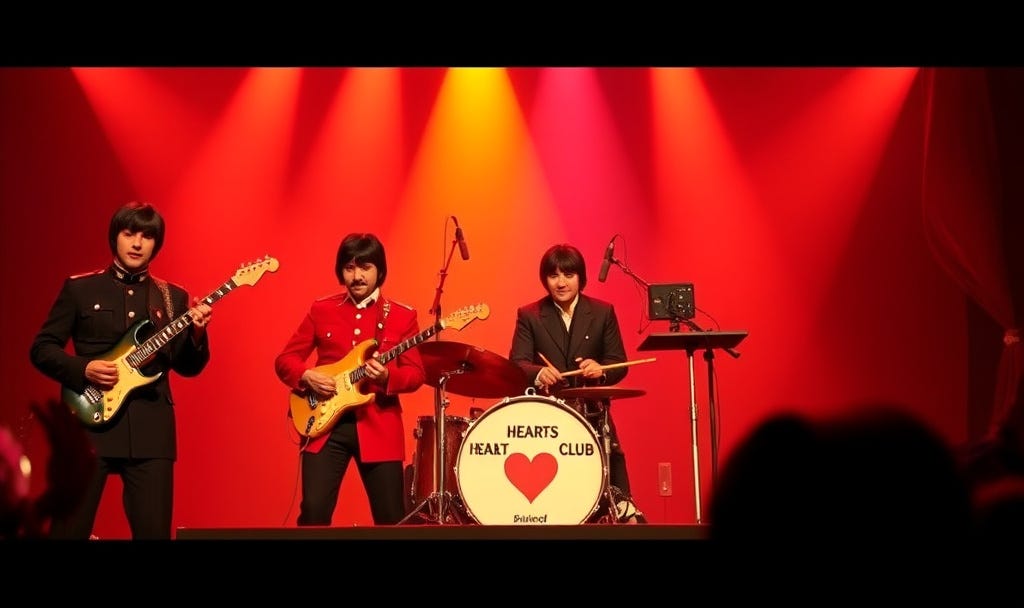
There was a crack like a snapping branch over the wind and a rectangular hole appeared in the brick face beside the door to the pharmacy next to Sally’s where a solid brick used to be. For a moment, it was just black till the air rushed in from the street and a light shone through, along with the sound of the Beatles from the radio inside the Pharmacy:
“Living is easy with eyes closed
Misunderstanding all you see
It’s getting hard to be someone, but it all works out
It doesn’t matter much to me.”
The light from the hole in the brickface streamed across the street like the bulb from a projection booth filling a dark theater, striking Walden on the chest and illuminating his entire body.
“Yow,” Bok said. He grabbed his paper bag before the crazy wind carried it across the street. Unless he hooked up with an older and wealthier friend who was feeling generous, he reminded himself, this liter bottle of Ausenflacker had to last him the whole day.
The glowing strip across the road made it look as if the asphalt was on fire. Two cars stopped on either side and traffic slowly accumulated. Twigs and sand and pebbles started spinning madly along the edges of the light.
Walden stood up slowly—he was five foot nine and two hundred fifty five pounds—and he stepped toward the street, his face full of dancing light, his short-cropped black hair brushed back in the gusty wind.
A black 1965 Cadillac Deville sedan pulled into the street parking lot close to the park bench.. A very well dressed and attractive young woman got out of the car and stood before Walden carrying a hypodermic needle and a piece of cotton.
“Walden,” she said, and her voice was friendly but authoritative, like a big sister. “You forgot your ten o’clock medication.”
She sounded like Lauren Bacall and walked like Audrey Hepburn.
“I’m sorry, Doctor Darla,” Walden said. “I got distracted.” He maintained his stare even at her approach. His sneakers took on the color of the light from the gap in the bricks, and the grass swayed back and forth like new wheat.
“I see that,” She pulled up a sleeve of his sweater to swab a patch of his upper arm, then injected him with the needle.
Walden’s eyelids quickly fell and, in a few seconds, the wind died down to a spring breeze. The storefront glass stopped shaking and the clouds opened a shard of sunlight directly over the park bench.
“Are you all right?” She put her hand on his shoulder.
The light from the storefront receded and dulled to black. The dust devils in the road dissolved into random handfuls of debris.
He cranked his neck around with seeming difficulty to meet her eyes. “I’m fine.”
“Good,” She put a hand under his forearm and slowly led him around the front of the Cadillac.
“Now, let’s get you home,” she said, leading him to the passenger door of her car. “You could use some rest.”
She looked at Bok and smiled. “He could use some rest,” she explained over the quickly dying wind.
And, with legendary nurse-like efficiency, she pulled out of the parking strip and headed south down Church Street to the Farragut’s house.
“Son of a bitch,” Bok said to himself, taking an extended gulp of Ausenflacker.
Tony the Deli man came out the front door, saw the brick lying on the side of the step. He glanced up at the empty space, grabbed the brick and slid it carefully into place, tapping it firmly in lieu of a mortar joint.
As the breeze died, Bok heard the last notes of the radio from the Pharmacy:
“Let me take you down ‘cause I’m going to
Strawberry Fields
Nothing is real
And nothing to get hung about…

The soft fizz of the remaining beer rang like a conch shell as he lifted the rim to his lips and the radio gave way to the tuba and accordion of the biergarten at the sunny and surreal 1964 World’s Fair.
In his memory’s eyes, He was twelve years old and on his way to the General Motors Pavilion to see FutureRama Two and ride in jet cars and watch spidery white robots mine the surface of the moon. The little town around the Unisphere was filled with light and promise and the future was an adventure without fear.